Working paper · Strategic studies and defense policy
Deterrence in Orbit PLA Counterspace Doctrine, JADO, and the Vulnerability of Space-Based Nuclear Command and Control
April 2026 · Preprint · Version 1
Abstract
The United States has simultaneously pursued nuclear command, control, and communications (NC3) modernization and doctrinal modernization through Joint All-Domain Operations (JADO). These two efforts proceed along largely separate institutional and intellectual tracks. This article examines whether JADO accounts for the nuclear escalation risks that PLA counterspace capabilities pose to dual-use space-based NC3 infrastructure. It bridges two bodies of scholarship that have developed in parallel: the nuclear-conventional entanglement framework and the emerging JADO doctrinal literature. The analysis introduces the “space-nuclear firewall” as an analytical concept, identifying not the structural condition of entanglement but the doctrinal assumption that entangled systems can be managed without differentiated treatment. The article argues that this assumed separation is operationally fictitious. PLA systems destruction warfare (体系破击战, tǐxì pòjī zhàn) treats the adversary’s operational system as a unified target set, prioritizing disruption of its information flows and command linkages. This doctrinal logic exploits the very distinction that JADO fails to operationalize. JADO’s emphasis on cross-domain convergence inadvertently deepens the entanglement problem. Optimizing for integration at the operational level obscures the strategic-level nuclear risks that convergence introduces in space. The article concludes that JADO does not position U.S. forces for success where the space and nuclear domains intersect. To address this structural vulnerability, it proposes a dedicated Space-Nuclear Integration Cell within the JADO planning architecture.
Keywords
- nuclear-conventional entanglement
- Joint All-Domain Operations (JADO)
- counterspace operations
- nuclear command, control, and communications (NC3)
- PLA systems destruction warfare
- space-nuclear firewall
- inadvertent escalation
- strategic stability
Contents
Introduction
The United States is simultaneously pursuing two modernization efforts that bear directly on its capacity to deter nuclear conflict. The first involves the comprehensive overhaul of nuclear command, control, and communications (NC3) infrastructure.1 The second is the doctrinal shift toward Joint All-Domain Operations (JADO), formalized in the September 2024 JP 3-0 revision.2 Both initiatives respond to the same strategic environment: great-power competition, contested domains, and growing adversary anti-access capabilities. Yet these two efforts proceed along largely separate institutional and intellectual tracks. NC3 modernization remains anchored within nuclear policy communities and their associated acquisition programs.3 JADO has developed primarily as an operational warfighting concept concerned with cross-domain convergence against conventional threats. The result is a doctrinal architecture in which the nuclear and conventional dimensions of space-based operations receive fundamentally different levels of analytical attention.
This institutional separation is consequential because the space domain does not permit it. The satellites upon which the United States depends for nuclear early warning, secure strategic communications, and attack assessment also enable conventional military operations.4 JADO doctrine recognizes that space is a contested warfighting domain. It emphasizes cross-domain convergence of effects across all operational environments.5 It does not, however, differentiate between the conventional support functions and the nuclear command-and-control functions these constellations simultaneously perform. The People’s Liberation Army (PLA), by contrast, draws no such distinction by design. Under its systems destruction warfare doctrine, the PLA treats the adversary’s operational system as a unified target set, severing C4ISR linkages as a precondition for battlefield success rather than as a supplementary objective.6 China’s growing counterspace arsenal gives this doctrinal ambition increasing material substance. That arsenal now spans direct-ascent antisatellite weapons, co-orbital systems, directed-energy platforms, and ground-based electronic warfare capabilities.7 Critically, the PLA’s rationale for degrading American conventional intelligence, surveillance, and reconnaissance (ISR) and its effect on the nuclear warning architecture are functionally identical. This mismatch between American doctrinal compartmentalization and Chinese operational holism creates escalation risks that neither JADO’s framework nor the existing literature has fully addressed.
A substantial body of scholarship has examined the escalation dangers arising from nuclear-conventional entanglement. Acton’s foundational analysis demonstrated that dual-use command-and-control assets create pathways for inadvertent nuclear escalation. Nonnuclear strikes against these systems can be misinterpreted as preparations for a disarming first strike, generating pressures that neither side intended.8 Talmadge identified the military-technical and perceptual conditions under which a conventional U.S.-China conflict could produce pressures for Chinese nuclear use, even absent a deliberate decision to cross the nuclear threshold.9 Research on Chinese strategic thinking suggests that Beijing may underestimate how counterspace operations against dual-use assets could trigger the very dynamics Chinese analysts believe they can control.10 Subsequent research mapping the dimensions and organizational drivers of entanglement within China’s force posture revealed that entanglement has emerged less from strategic choice than from institutional bureaucratic processes.11 Collectively, this literature establishes that the boundary between conventional and nuclear operations is far more porous than policy frameworks assume. Yet none of these analyses has examined how JADO’s all-domain integration framework interacts with these dynamics, particularly in the space domain where entanglement is most acute.
This article addresses that gap through two related inquiries. First, to what extent does JADO’s doctrinal framework account for the nuclear escalation risks introduced by PLA counterspace capabilities targeting dual-use space-based NC3 infrastructure? Second, does JADO position U.S. forces for success in a conflict where the space and nuclear domains converge? To answer these questions, the article introduces the concept of the “space-nuclear firewall.” The concept describes a critical doctrinal assumption: that conventional space operations and nuclear C3 functions can be managed within a unified domain framework without triggering escalation. The article argues that this assumed separation is operationally fictitious. PLA counterspace doctrine is specifically designed to collapse it. The 2022 Nuclear Posture Review acknowledged that non-nuclear strategic attacks on NC3 could warrant nuclear response, yet JADO provides no mechanism to operationalize this threshold in the space domain.12 The result is a structural vulnerability in U.S. joint doctrine. JADO leaves American forces doctrinally unprepared for an adversary whose theory of victory targets the information architecture upon which nuclear deterrence depends.
The analysis proceeds in five sections. Section II develops the theoretical framework by applying entanglement theory to the space domain. It establishes the escalation mechanisms through which counterspace operations can cross the nuclear threshold. Section III examines PLA counterspace doctrine, demonstrating how systems destruction warfare targets the information architecture upon which both conventional operations and nuclear deterrence depend. Section IV analyzes JADO’s treatment of the space domain and identifies structural gaps in its escalation management framework. Section V synthesizes these threads to demonstrate the escalation dynamics that emerge when PLA counterspace operations encounter JADO’s doctrinal blind spot. Section VI offers policy recommendations, including a dedicated Space-Nuclear Integration Cell within the JADO planning architecture.
Entanglement, Escalation, and the Space Domain: A Theoretical Framework
The escalation risks posed by nuclear-conventional entanglement are not new to the strategic studies literature. Yet their application to the space domain reveals dynamics that existing theoretical treatments have not fully developed. Acton’s foundational analysis identified two mechanisms through which the entanglement of nuclear and conventional command, control, communications, and intelligence (C3I) systems can produce inadvertent nuclear escalation.13 Comparative research on Russian and Chinese perspectives confirmed that these risks are recognized across nuclear-armed states, though differently weighted.14 Subsequent work extended this logic to the cyber domain, demonstrating that nonnuclear cyber operations against C3I systems generate parallel escalation pathways.15 The first mechanism, misinterpreted warning, occurs when nonnuclear strikes against dual-use assets are perceived by the target state as the opening phase of a disarming nuclear attack.16 The second, the damage-limitation window, emerges when degradation of an adversary’s nuclear C3I generates pressure to escalate preemptively, before the capacity for assured retaliation erodes further.17 Both mechanisms operate through the structural properties of the systems rather than through deliberate escalatory intent. They are not amenable to the competitive risk manipulation upon which conventional escalation management depends.18 Emerging military technologies accelerate the pace at which these structural vulnerabilities can be exploited.19 Earlier scholarship anticipated this logic by demonstrating that conventional operations can produce nuclear escalation pressures through their operational effects rather than through political decisions to cross the nuclear threshold.20 What neither analysis systematically addressed, however, is the domain in which these dynamics are most concentrated: outer space.
The space domain concentrates entanglement to a degree unmatched in any other operational environment. The satellites upon which the United States relies for nuclear mission assurance are, in most cases, the same platforms that enable conventional warfighting.21 The Department of Defense defines NC3 as the assured system enabling presidential authorization and direction of nuclear operations, encompassing detection, warning, attack characterization, and force management.22 The Space Based Infrared System (SBIRS) and its successor, the Next Generation Overhead Persistent Infrared (Next-Gen OPIR) constellation, provide missile warning data that supports both nuclear attack assessment and conventional theater missile defense. The Advanced Extremely High Frequency (AEHF) satellite system and its planned successor, the Evolved Strategic SATCOM (ESS), carry presidential nuclear directives alongside routine operational communications. GPS III enables both precision conventional strike and nuclear weapons delivery, while the Mobile User Objective System (MUOS) supports tactical communications across the conventional-nuclear spectrum.23 The foundational principle that nuclear deterrence rests upon survivable retaliatory capabilities means that any degradation of these constellations carries implications beyond the conventional battlefield.24 Any adversary strike against these systems, regardless of intended scope, simultaneously affects nuclear command and control.25 The vulnerability of NC3 to degradation through both kinetic and nonkinetic means has been identified as among the most consequential threats to strategic stability.26 Cyber warfare technologies compound this vulnerability by offering pathways to degrade satellite ground segments without the physical destruction that might provide clearer escalatory signals.27
The structural concentration of entanglement in space intersects with a second theoretical dynamic: the stability-instability paradox. Snyder’s original formulation held that mutual nuclear deterrence at the strategic level can paradoxically embolden states to pursue aggression at lower levels of conflict.28 Subsequent scholarship has confirmed this operative logic across the U.S.-China relationship, emerging military technologies, and quantitative analysis, establishing that strategic stability enables greater conflict at lower levels.29 Applied to counterspace operations, the paradox assumes a structural dimension. If PLA strategists assess that nuclear stability insulates against uncontrolled escalation, they may calculate that conventional counterspace strikes will remain below the nuclear threshold. Yet the dual-use nature of American space architecture means this calculation is structurally unfounded.30 Both the 2022 and 2018 Nuclear Posture Reviews acknowledged that non-nuclear strategic strikes against NC3 infrastructure could cross the threshold for nuclear retaliation.31 Yet no doctrinal mechanism prevents the paradox from operating in space. What appears from Beijing’s perspective as a conventional counterspace strike may, from Washington’s perspective, constitute degradation of nuclear command and control.
Talmadge’s analysis of Chinese nuclear escalation risk identifies the specific conditions under which such miscalculation becomes most dangerous. Her framework isolates two categories of escalation driver. The first is military-technical: the physical conduct of conventional operations inadvertently threatens nuclear forces. The second is perceptual: one side misreads the other’s intentions based on observed military activity.32 PLA counterspace operations against dual-use space assets engage both categories simultaneously. At the military-technical level, strikes that degrade space-based missile warning compress the timelines available for nuclear decision-making.33 At the perceptual level, the United States cannot readily distinguish between PLA counterspace operations aimed at degrading conventional ISR and those constituting preparatory stages of a nuclear counterforce campaign. Research on Chinese strategic thinking compounds this concern. PLA analysts maintain considerable confidence in their ability to control escalation during conventional conflict.34 This disposition suggests that Chinese decision-makers may systematically underestimate the escalatory potential of counterspace operations that, from a conventional standpoint, appear strategically rational.35
These escalation dynamics acquire additional gravity within the broader transformation of nuclear deterrence that Lieber and Press have documented. Their research demonstrates that advances in remote sensing, precision guidance, and weapons accuracy have progressively eroded the survivability of nuclear forces once considered secure. The pursuit of what they term strategic primacy now spans multiple domains, including ISR and command-and-control architectures resident in space.36 The spread of strategic non-nuclear weapons signals a third nuclear age, where technologies capable of strategic effect without nuclear use erode the conventional-nuclear divide.37 Counterspace operations represent a critical dimension of this transformation. PLA strikes against space-based missile warning and strategic communications functionally replicate the conditions of a nuclear counterforce attack by undermining assured retaliation.38 Jervis’s foundational insight that the nuclear revolution rests upon the mutual capacity for assured destruction thus acquires new significance in the space domain.39 When the enabling architecture of retaliation can be degraded through nonnuclear means, deterrence stability becomes contingent upon the survivability of the command-and-control system rather than the survivability of the weapons themselves.
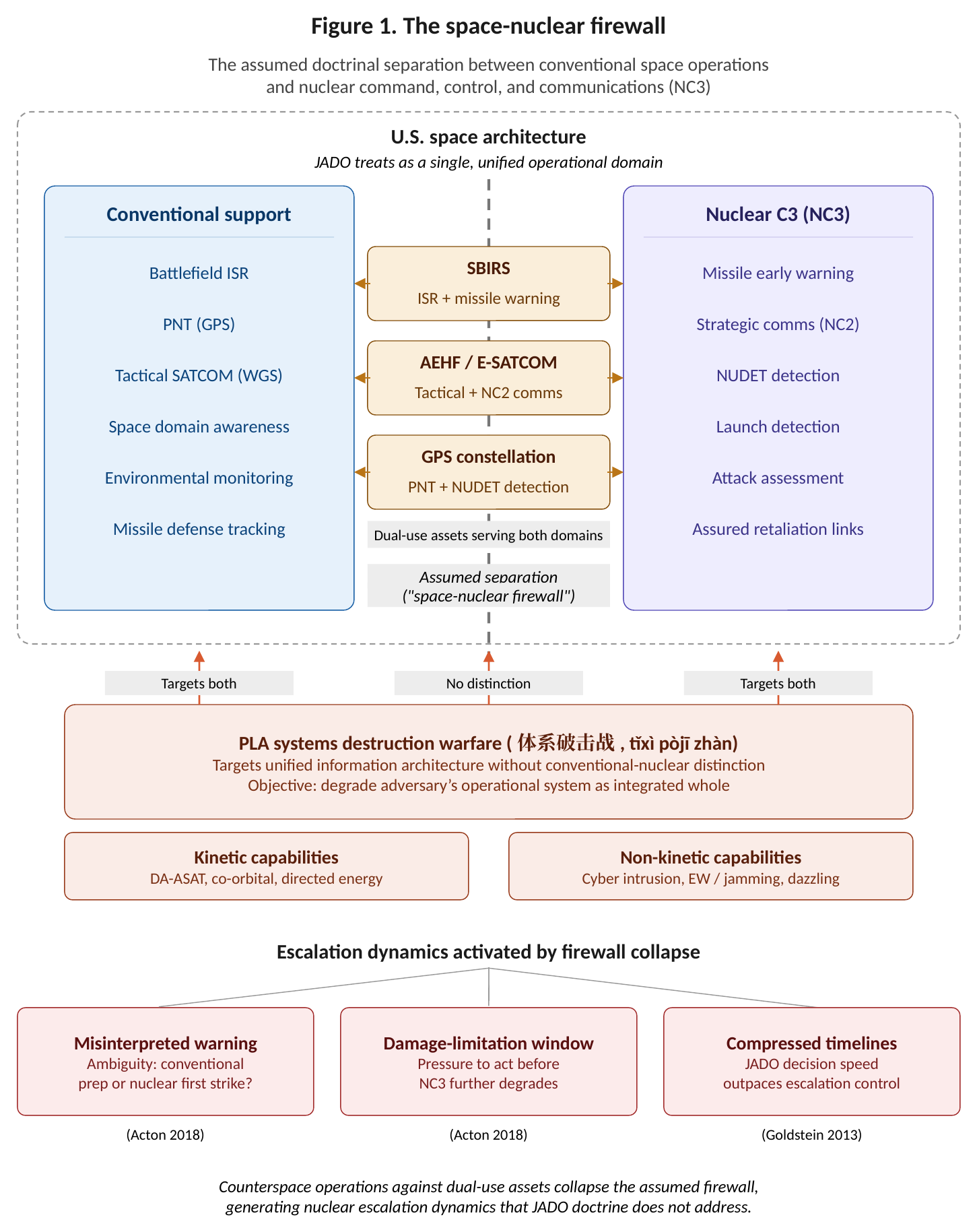
These converging theoretical dynamics point toward a single analytical concept that organizes the remainder of this article: the space-nuclear firewall. The concept is distinct from entanglement itself. Entanglement describes a structural condition: the conflating of nuclear and conventional functions within shared platforms. The space-nuclear firewall names the doctrinal assumption that this merging can be operationally managed within a unified framework without triggering escalation. It identifies not the physical overlap of systems but the institutional presumption that overlap requires no differentiated treatment. The preceding analysis demonstrates that this assumption is theoretically unfounded. The stability-instability paradox, the military-technical and perceptual drivers of inadvertent escalation, and the counterforce implications of space-based NC3 degradation converge on a shared conclusion. The conventional-nuclear boundary in space cannot be sustained under operational conditions. PLA doctrine, as the following section demonstrates, is designed to exploit precisely this condition.40 The risk of catalytic escalation compounds this dynamic: as degraded NC3 forces both sides into faster, more automated decision cycles, the potential for escalation driven by information failures rather than deliberate choices grows markedly.41 The space-nuclear firewall therefore serves as the evaluative lens through which the remaining sections assess whether JADO positions U.S. forces for success.
PLA Counterspace Doctrine: Systems Destruction and the Information Center of Gravity
The doctrinal architecture underpinning PLA counterspace operations developed from a broader reconceptualization of warfare. The PLA’s study of American operations in the Persian Gulf, Kosovo, and Iraq persuaded Chinese strategists that information had become the decisive factor in modern combat. Destroying an adversary’s command-and-control linkages shifted from a supporting task to the central operational requirement.42 The PLA codified this insight through two sequential doctrinal paradigms. The first, informationized warfare (信息化战争, xìnxī huà zhànzhēng), posited that future conflicts would be decided by the capacity to acquire, transmit, and exploit information faster than the adversary.43 This approach emphasized integrating all available capabilities to disrupt and paralyze an adversary’s operational system rather than seeking the outright destruction of its forces. The PLA’s 1999 joint campaign outline adopted this approach as the guiding thought for future campaigns, marking a decisive break from Mao-era doctrine.44 The second paradigm, intelligentized warfare (智能化战争, zhìnéng huà zhànzhēng), extends this logic further. It incorporates artificial intelligence, autonomous systems, and big-data analytics into every level of military operations. The 2020 edition of the Science of Military Strategy frames the information domain as the locus of future guidance. It declares that information warfare, network warfare, and intelligent warfare will constitute the focus of combat direction in wars to come.45
Official PRC defense publications confirm and reinforce this doctrinal trajectory. The 2015 defense white paper stated that the PLA would conduct informationized warfare through information-based system-of-systems operations (基于信息系统的体系作战, jīyú xìnxī xìtǒng de tǐxì zuòzhàn). It identified outer space and cyberspace as critical security domains requiring accelerated capability development.46 The PLA conceptualizes intelligentization as a stage beyond informatization. This transition requires transformative changes in force development. AI serves as a critical force multiplier across intelligence processing, command decision-making, and autonomous systems.47 The PLA has consistently deepened its investment in the information-systems architecture required to wage systems warfare. Joint operations and systems confrontation function as inextricable dimensions of the same operational logic.48 Space occupies a privileged position within this architecture. The PLA regards space not as an adjunct capability but as an integral component of its operational system. It is essential for enabling long-range precision strikes, joint command, and real-time intelligence fusion.49 The 2019 defense white paper reiterated this assessment. It called for accelerating strategic support force modernization so that new-type combat forces could meet the demands of informationized and intelligentized conflict.50
The PLA’s organizational architecture for space and counterspace operations has undergone significant restructuring. These changes reflect the growing centrality of the information domain. In December 2015, Beijing created the Strategic Support Force (SSF) as a unified command for strategic-level capabilities. The SSF integrated space, cyber, electronic warfare, and psychological operations under one organization with direct reporting authority to the Central Military Commission (CMC). In April 2024, the CMC dissolved the SSF after only eight years. The CMC realigned the SSF’s subordinate elements under three new organizations. The Aerospace Force (航天部队, hángtiān bùduì) assumed responsibility for military space and counterspace operations. The Cyberspace Force (网络空间部队, wǎnglò kōngjiān bùduì) was charged with cyber operations, electronic warfare, technical reconnaissance, and psychological warfare. The Information Support Force (信息支援部队, xìnxī zhīyuán bùduì) took responsibility for managing the PLA’s network information architecture and delivering communications support across the joint force.51 All three entities now report directly to the CMC as deputy-theater-grade service arms. This structural elevation signals Beijing’s assessment that information-domain capabilities require tighter central control. The 2025 OSD report notes that the Information Support Force is intended to integrate network-centric warfare into joint operations. It collaborates closely with the Aerospace Force and Cyberspace Force to fuse electronic warfare, information operations, and counterspace activities.52
This reorganization reveals two analytically important features of PLA counterspace thinking. First, it confirms that PLA doctrine treats space, cyber, and electromagnetic operations as dimensions of a single information confrontation problem. These are not separate warfighting domains amenable to isolated management. The operational logic of systems destruction warfare (体系破击战, tǐxì pòjī zhàn) requires severing the adversary’s C4ISR linkages through coordinated, multi-vector attack across these domains simultaneously.53 Second, the employment authority for different counterspace weapon classes is distributed across multiple echelons. The CMC, theater commands, and several PLA services share this authority rather than concentrating it within a single organization. Kinetic weapons producing irreversible effects, such as DA-ASAT missiles, require CMC-level authorization. Reversible capabilities like directed-energy dazzling and certain electronic spectrum operations can be tasked at the theater level.54 This differentiated command architecture indicates that the PLA calibrates its counterspace employment decisions along a spectrum of reversibility and strategic consequence. The distinction carries important implications for escalation dynamics.
The PLA’s counterspace capabilities now span a comprehensive range of technologies designed to threaten satellite operations across all orbital regimes. The informationized warfare paradigm has driven the development of both kinetic and non-kinetic means of space control.55 At the kinetic end of the spectrum, China conducted its first destructive DA-ASAT test in January 2007. It intercepted a defunct weather satellite in low Earth orbit, generating a debris field that remains a hazard to space operations.56 Subsequent tests in 2013 and 2014, along with an additional test in July 2017 confirmed by Chinese official media in 2021, demonstrated continued development of kinetic counterspace capabilities.57 The 2025 CSIS Space Threat Assessment confirms that China retains ground-based DA-ASAT capability. It documents that China’s counterspace emphasis in 2024 shifted toward increasingly sophisticated co-orbital rendezvous and proximity operations, suggesting a maturing posture across the counterspace spectrum.58
Beyond kinetic kill vehicles, the PLA has invested extensively in non-kinetic counterspace capabilities. These include co-orbital rendezvous and proximity operations using satellites equipped with robotic arms, as well as directed-energy systems capable of dazzling or blinding electro-optical sensors on early warning satellites. Ground-based jamming and spoofing of GPS and satellite communications, along with offensive cyber operations against satellite ground segments and telemetry networks, complete the spectrum.59 These capabilities span a spectrum of reversibility and attribution difficulty. Non-kinetic methods such as jamming and dazzling produce temporary, often ambiguous effects that complicate an adversary’s ability to characterize the attack and calibrate a proportional response.60 The early development of China’s counterspace architecture reflected a core PLA assessment. The United States relies on space for much of its intelligence and communications, creating an asymmetric vulnerability that counterspace weapons are designed to exploit.61
The cyber dimension is particularly significant because it bridges peacetime preparation and wartime execution. Pre-positioning access within adversary networks during peacetime, often indistinguishable from espionage, creates novel escalation risks when a crisis erupts. PLA doctrine applies this logic directly to space systems through two categories of cyberattack. The first involves network-electromagnetic spectrum operations that deliver disruptive code through radio-frequency pathways into satellite ground stations and telemetry links. The second involves covert intrusion operations that pre-position malicious code within adversary satellite information systems for activation during a conflict.62 The PLA’s investment in counterspace and cyber capabilities represents a deliberate strategic substitution. Beijing concluded that nuclear escalation offered diminishing returns as coercive leverage against the United States. Information-domain capabilities offered a more calibrated and usable form of strategic influence.63 China’s nuclear evolution aimed less at strategic parity than at securing a retaliatory capability sufficient to free conventional forces for employment without triggering uncontrolled escalation.64
The preceding analysis converges on the critical observation that animates this article’s central argument. PLA counterspace doctrine does not distinguish between conventional and nuclear space targets. Systems destruction warfare treats the adversary’s operational system as an integrated whole. It targets the information flows and command linkages that bind the system together, regardless of whether those linkages serve conventional or nuclear functions.65 The Chinese contributors to Acton’s study of entanglement acknowledged that non-nuclear strikes against dual-use command-and-control systems could generate nuclear escalation risks. Yet they framed these risks as manageable features of a conflict environment rather than as prohibitive constraints on operations.66 The 2020 Science of Military Strategy reinforces this disposition. It instructs war directors to identify and strike the strong points, weaknesses, and joints of the enemy’s combat system using multi-domain integrated operations.67 The PLA’s doctrinal rationale for targeting early warning satellites such as the Space Based Infrared System illustrates this logic concretely. Degrading these satellites to reduce conventional ISR simultaneously degrades the nuclear warning architecture upon which American second-strike confidence depends. This is not a deficiency in PLA doctrine. It is the operational logic of systems confrontation applied without regard to the nuclear functions embedded within the target set.68 The question, then, is whether JADO’s framework for organizing space operations can respond to a threat architecture specifically designed to collapse the conventional-nuclear boundary. The following section examines that framework.
JADO and the Space Domain: Doctrinal Aspirations and Structural Gaps
The doctrinal evolution that produced Joint All-Domain Operations unfolded across four decades of institutional learning. AirLand Battle, codified in the 1982 edition of FM 100-5, organized combat power across two domains and emphasized synchronized fires and maneuver to defeat Soviet echeloned forces. Full-spectrum operations, adopted in the early 2000s, expanded the framework to account for stability and reconstruction tasks alongside conventional combat. The Army’s Multi-Domain Operations concept, published in 2018 as TRADOC Pamphlet 525-3-1, represented a more fundamental departure. It framed the core military challenge as penetrating multiple layers of adversary standoff spanning space, cyberspace, the electromagnetic spectrum, and the information environment.69 The September 2024 revision of JP 3-0 formalized this trajectory at the joint level. Appendix D established JADO as the doctrinal framework through which joint force commanders integrate capabilities across all domains to create convergent effects against capable adversaries.70 The joint force is attempting to build a fundamentally new operational architecture from assets that are not yet coordinated for the environment it anticipates.71 Each successive doctrinal iteration broadened the number of domains to be integrated. None proportionally expanded the escalation management framework to account for the strategic consequences of operating across domains where conventional and nuclear functions are commingled.
JADO makes several important doctrinal contributions. The Multi-Domain Operations concept recognized that adversaries like China and Russia had developed layered anti-access and area denial systems devised to fracture the joint force’s ability to integrate across domains.72 JP 3-0 establishes that joint warfighting demands the integration of all domains rather than the deconflicted, service-centric approaches that characterized earlier doctrine.73 AFDP 3-99 complements this vision by framing JADO’s desired outcome as the convergence of effects across all domains at a measure that outpaces adversary decision-making.74 Appendix D directs planners to develop concepts of operations that integrate space, cyberspace, and electromagnetic spectrum capabilities into their schemes of maneuver, fires, and logistics. It further requires that targeting across all domains account for adversary counterspace capabilities as part of CONOPS development.75 JP 3-14 defines space superiority as the degree of control permitting freedom of access and action without prohibitive adversary interference. It identifies ten distinct space mission areas, including missile warning, satellite communications, and nuclear detonation detection, that enable joint force operations across the competition continuum.76 These are substantive doctrinal achievements. JADO has correctly diagnosed the operational problem: adversaries possess the means and intent to deny American space capabilities. The doctrine frames the response primarily as a question of resilience, redundancy, and cross-domain synergy. What it does not adequately address is the escalation management dimension of that problem.
The structural gap in JADO emerges from its treatment of the space domain as a unified operational construct. Neither JP 3-0 Appendix D nor AFDP 3-99 systematically distinguishes between conventional space support functions and nuclear C3 functions when discussing cross-domain integration, targeting, or escalation control. Appendix D directs space planners to identify enemy threats to missile warning, space domain awareness, and communications satellites.77 It does not, however, differentiate between threats to conventional ISR and threats to the nuclear warning and strategic communications architecture that these same constellations support. The Evans study commissioned by the U.S. Space Force found that the dual-use character of American space architecture complicates adversary assessments of whether strikes constitute conventional preparation or the opening phase of a strategic attack. This ambiguity, the study concluded, could generate rapid and potentially unintended military escalation.78 AFDP 3-99 itself identifies two areas requiring further doctrinal development: more agile support relationships and joint command and control at all echelons under degraded communications.79 Neither of these acknowledged gaps addresses the nuclear escalation dimension of space operations.
This analysis is necessarily confined to the doctrinal level. Classified operational planning may partially address this gap through informal coordination mechanisms not visible in published doctrine. The absence of formal doctrinal guidance, however, means that any such mitigation remains ad hoc rather than institutionalized across the joint force. Doctrine nonetheless shapes institutional behavior, training curricula, and planning defaults. Even where classified mechanisms address specific contingencies, the absence of formal guidance ensures that escalation awareness depends on individual expertise rather than systemic institutional design.
This omission becomes more consequential when examined against the Air Force’s own nuclear operations doctrine. AFDP 3-72 establishes that nuclear command, control, and communications constitute the foundation of national defense. The decision to employ nuclear weapons is strictly controlled at the presidential level.80 The 2022 Nuclear Posture Review compounds this tension. It warns that non-nuclear capabilities in the cyber, space, air, and undersea domains will create complex and unpredictable pathways for conflict escalation. The NPR identifies this risk as particularly acute where collective experience and established norms of behavior are lacking.81 The NPR further identifies a narrow range of non-nuclear strategic-level attacks for which nuclear weapons may be necessary as a deterrent. Attacks that degrade NC3 fall within this category. Yet JADO doctrine provides no mechanism to operationalize this declaratory threshold within the space domain. Hays and Mineiro have argued that deliberate degradation or destruction of NC3 capabilities constitutes a red line for senior American decision-makers, one whose breach could trigger nuclear escalation.82 JADO’s planning framework contains no corresponding escalation threshold and no doctrinal trigger that distinguishes counterspace operations affecting conventional support from those degrading the nuclear command architecture.
A deeper paradox compounds this gap. JADO’s central operational virtue, the convergence of effects across all domains, simultaneously deepens the entanglement that generates escalation risk. By optimizing for speed, integration, and cross-domain synergy, the doctrine makes it structurally harder to isolate nuclear C3 functions from the broader operational architecture. Even reversible counterspace capabilities risk escalation if their intent is misinterpreted by adversaries. The perceived advantages of striking first in space make the early employment of offensive capabilities plausible.83 The space-based NC3 system was originally placed in orbit because the domain provided unique speed, global perspective, and positional advantages. Those same attributes now make the system’s components high-value targets in any conflict where an adversary seeks to degrade American operational coherence.84 JADO’s emphasis on integrating space assets into every aspect of joint operations means that defending these assets has become a condition of operational success. Yet this very integration ensures that any adversary attack against the integrated system simultaneously threatens nuclear command and control. The convergence that gives JADO its operational power makes the space-nuclear firewall thinner, not thicker.
JADO fails to prepare American forces for a conflict in which the adversary’s primary doctrinal objective is to destroy the information system upon which both JADO and nuclear deterrence depend. The doctrine’s treatment of space as a single domain without differentiating its conventional and nuclear functions creates a structural vulnerability. PLA systems destruction warfare, as documented in the preceding section, is specifically designed to exploit unified information architectures. Complexity analysis underscores this concern: the more tightly integrated a system’s components become, the more vulnerable the system grows to attacks targeting its connective architecture.85 JADO’s operational logic is sound in its diagnosis of the multi-domain threat environment. But the doctrine’s failure to account for the nuclear escalation dynamics that this convergence introduces in the space domain constitutes a gap with strategic consequences. The following section examines those consequences by tracing the escalation dynamics that emerge when PLA counterspace operations encounter this doctrinal blind spot.
Counterspace Operations and the Collapse of the Space-Nuclear Firewall
These dynamics become concrete when projected against a specific scenario. Consider a Taiwan contingency in which the PLA employs counterspace capabilities against American space assets during the opening phase of cross-strait operations. PLA doctrine treats the adversary’s information architecture as a unified target set, making early strikes against space-based command nodes a doctrinal imperative rather than a contingency.86 The 2025 China Military Power Report confirms that the PLA plans to conduct both kinetic and nonkinetic antisatellite operations during a conflict with the United States and possesses sufficient reversible counterspace inventory to execute them with little warning.87 A direct-ascent antisatellite strike against a SBIRS satellite in geosynchronous orbit or a co-orbital engagement in the OPIR constellation88 simultaneously degrades two functionally distinct capabilities: conventional theater missile defense awareness and nuclear early warning for STRATCOM’s attack assessment.89 American decision-makers must determine whether such strikes represent conventional battlefield preparation or the opening phase of a nuclear counterforce campaign.90 Acton’s concept of misinterpreted warning describes precisely this pathway: nonnuclear strikes on dual-use command infrastructure generate ambiguity about the adversary’s intentions that the targeted state cannot resolve under the compressed timelines of active conflict.91 The risk is not that Chinese leaders intend nuclear escalation; it is that their counterspace operations produce effects operationally indistinguishable from the preparatory steps of a disarming first strike.92
This ambiguity activates Acton’s damage-limitation window. If American decision-makers conclude that PLA strikes are progressively degrading NC3 to the point where assured retaliation becomes uncertain, they face acute pressure to act before further degradation forecloses their options.93 The logic is sequential. Degradation of space-based missile warning compresses the time available for attack assessment. Degradation of strategic communications introduces doubt about the reliability of retaliatory command links. The combination generates conditions under which decision-makers may perceive that delay itself constitutes an unacceptable strategic risk.94 This conclusion is reinforced from the inverse direction. The pressures most likely to trigger Chinese nuclear use stem less from direct military vulnerabilities than from what Beijing perceives U.S. military-technical developments to signal about American wartime intentions.95 The finding that Chinese strategists exhibit confidence in their ability to control escalation below the nuclear threshold deepens this concern. If PLA planners believe counterspace operations remain firmly within the conventional domain, they may underestimate how such operations activate the very escalation mechanisms they believe they can avoid.96 JADO’s emphasis on rapid cross-domain response compounds this pressure by shortening the decision cycles within which these assessments must occur.97 The compressed timelines identified as the most dangerous feature of U.S.-China crisis interaction are a product of the doctrinal architecture itself.98 Earlier work on nuclear stability anticipates this dynamic, arguing that integrating strategic warning systems into broader information networks creates pathways for cascading failure that no single operator can fully anticipate.99
Converging scholarship reinforces this assessment. Cyber intrusions against NC3 networks generate crisis instability even during peacetime, yet kinetic destruction of space-based NC3 hardware produces far more irreversible effects.100 Space-based ISR serves as the primary enabler of counterforce capabilities that progressively erode the survivability of nuclear retaliatory forces.101 Protracted conventional conflict in Asia would gradually degrade conventional-nuclear barriers through PLA force structure and deployment patterns.102 China’s evolving nuclear posture is itself a response to entanglement pressures, creating a feedback loop in which counterspace operations exacerbate the very dynamics driving nuclear force expansion.103 Where emerging capabilities outpace the institutional frameworks governing their employment, the risk of uncontrolled escalation is greatest.104
The most developed counterargument to this analysis merits direct engagement. Wu Riqiang contends that China’s centralized NC3 architecture and doctrinal restraints, including its no-first-use commitment, substantially reduce the probability of inadvertent nuclear escalation in a conventional conflict.105 His assessment rests on the premise that Chinese command linkages would remain sufficiently functional during a conflict to permit deliberate decision-making at the national level. This premise is precisely what the preceding analysis calls into question. Acton’s evaluation of NC3 survivability identified significant uncertainty in Wu’s conclusions, observing that his assessment of Chinese communication resilience depends on assumptions about system design that remain unverifiable in open sources.106 More fundamentally, the restraint-based logic Wu advances presupposes the very conditions that counterspace operations are designed to eliminate: intact early warning, reliable strategic communications, and sufficient decision time for centralized authority to function as intended. This article has demonstrated that PLA counterspace operations would degrade all three simultaneously. Wu himself concedes that dual-use assets constitute targets whose destruction automatically degrades nuclear capabilities regardless of the attacker’s intent.107 Doctrinal commitments to escalation control cannot compensate for material degradation of the command architecture through which that control must be exercised.
The escalation dynamics traced in this section converge on a single structural finding: the space-nuclear firewall that JADO implicitly assumes is operationally fictitious. Schelling’s foundational insight that deterrence rests on the manipulation of shared risk illuminates why this matters.108 The dual-use character of space-based NC3 transforms every counterspace engagement into a manipulation of nuclear risk, whether the attacker intends it or not. Jervis extended this logic by demonstrating that mutual vulnerability cannot be surgically managed through limited operations against the systems that sustain it.109
Critically, compressed decision timelines and asymmetric threat perceptions constitute the conditions most conducive to catastrophic miscalculation.110 Beijing’s expanding arsenal compounds this instability, yet its own framework for managing nuclear risk does not account for the entanglement dynamics that its counterspace doctrine generates.111 This disjunction between doctrinal confidence and operational reality characterizes both the Chinese and Russian approaches to nonnuclear weapons carrying nuclear risks.112 The critical variable in strategic stability is the survivability of the retaliatory architecture, not merely the warheads. China’s nuclear force expansion without corresponding attention to the command architecture’s vulnerability creates a deterrent dependent on infrastructure that JADO cannot protect and that was designed before the current counterspace threat environment emerged.113
The 2022 Nuclear Posture Review’s warning that non-nuclear strategic attacks on NC3 could trigger nuclear escalation remains a declaratory statement without doctrinal operationalization within JADO.114 The result is a structural vulnerability in American joint doctrine: JADO optimizes for cross-domain integration while failing to account for the nuclear escalation risks this integration introduces in the space domain. American forces are left doctrinally unprepared for a conflict in which escalation dynamics outpace operational guidance.115
Recommendations
Addressing this structural vulnerability requires reforms across four interconnected areas. The first is doctrinal differentiation. JP 3-0 Appendix D must be supplemented with an explicit space-nuclear escalation management framework that establishes distinct thresholds for operations involving NC3-relevant assets. Hays and Mineiro observe that NC3 and combined joint all-domain command and control systems must be both distinct and integrated. NC3 imposes requirements for positive and negative control that no other command system shares.116 Without this differentiation, JADO planners lack the doctrinal guidance necessary to distinguish counterspace operations affecting conventional support from those degrading the nuclear command architecture. The current unified domain construct effectively requires planners to treat conventional ISR satellites and nuclear early warning constellations as operationally equivalent for targeting and escalation purposes. The doctrine cannot answer its own operational question of how to achieve cross-domain convergence without crossing nuclear thresholds.
The second reform concerns operational disaggregation. Where technically feasible, nuclear C3 functions should be architecturally separated from conventional space support. Proliferated low Earth orbit constellations such as the Space Development Agency’s Transport Layer enhance conventional resilience through distribution and redundancy. They do not, however, inherently address nuclear-specific survivability requirements. The Department of Defense’s transition toward a proliferated architecture may not appropriately prioritize requirements essential to NC3 missions.117 This risk intensifies where separate acquisition organizations pursue divergent timelines and standards. The Evolved Strategic SATCOM program must be evaluated through a nuclear survivability lens rather than merely as a successor to the Advanced Extremely High Frequency system. The United States must also develop the capacity for rapid reconstitution of space-based NC3 assets. The logic is analogous to the survivable second strike that underpins the nuclear triad.118 This is a force design question with direct implications for whether the joint force can sustain conventional operations and nuclear deterrence simultaneously under counterspace attack. The risk compounds as degraded NC3 forces both sides toward faster and more automated decision cycles at precisely the moment when deliberation matters most.
Third, declaratory policy must function as an operational enabler rather than an aspirational statement. The 2022 Nuclear Posture Review warned that non-nuclear strategic attacks on NC3 could warrant nuclear response. Yet JADO provides no mechanism to give this threshold operational meaning. Cross-domain operations produce complicating effects on escalation control. Decision-makers may perceive actions in space and cyberspace differently from those involving nuclear weapons.119 If this declaratory threshold is to function as a deterrent, three elements are necessary. These include visible force posture adjustments, pre-delegated response authorities for NC3 defense, and integration into JADO planning processes. This means, at minimum, dedicated NC3 defense capabilities whose existence adversaries can observe and that doctrine explicitly accounts for. Ambiguity here does not strengthen deterrence. It invites the miscalculation that the entanglement literature describes.
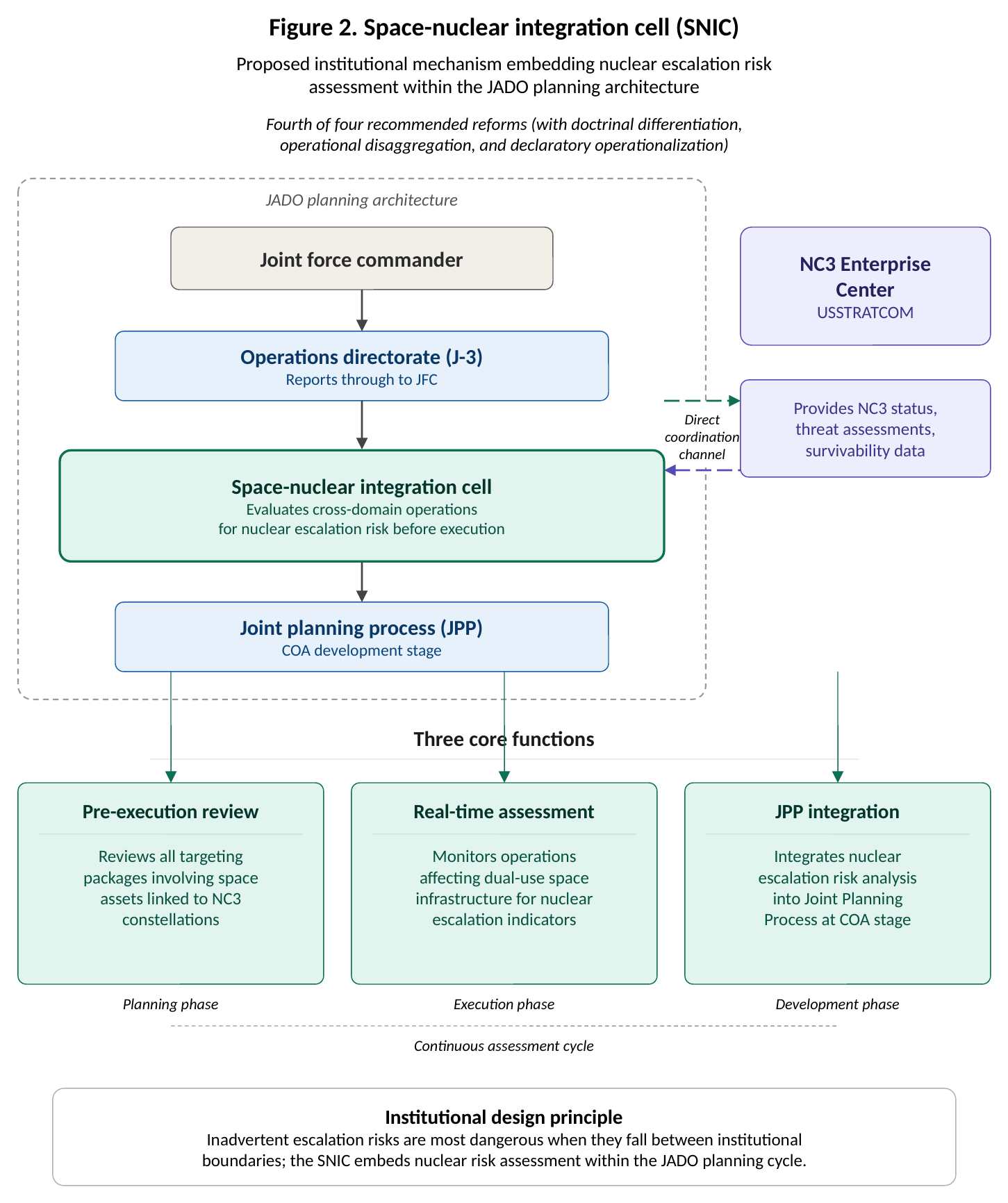
Fourth, and most consequentially, this article proposes a dedicated Space-Nuclear Integration Cell within the JADO planning architecture. The cell would be specifically tasked with evaluating cross-domain operations for nuclear escalation risk before execution. It would report to the joint force commander through the operations directorate. The cell would also maintain a direct coordination channel to the NC3 Enterprise Center at U.S. Strategic Command. Its mandate would encompass three core functions. The first is pre-execution review of all targeting packages involving space assets linked to NC3 constellations. The second is real-time escalation assessment during operations affecting dual-use space infrastructure. The third is integration of nuclear escalation risk analysis into the Joint Planning Process at the course-of-action development stage. The institutional precondition for such a mechanism is clear: merging systems from organizations with competing institutional priorities into a cohesive NC3 system-of-systems demands sustained organizational focus.120 Integrating nuclear deterrence into a nonnuclear strategy presents practical challenges requiring further examination.121 During joint operations, the cell would serve as the institutional mechanism through which the space-nuclear firewall is monitored and enforced in real time. The Space-Nuclear Integration Cell operationalizes the insight that inadvertent escalation risks prove most dangerous when they fall between institutional boundaries. By embedding nuclear escalation assessment within the JADO planning cycle, the cell would ensure that the space-nuclear firewall receives doctrinal enforcement rather than implicit assumption.
The structural vulnerability identified in this analysis is not confined to the U.S.-China dyad. Russia possesses parallel counterspace capabilities, including a space-based nuclear antisatellite weapon under development and co-orbital systems deployed in orbital patterns shadowing American government satellites.122 The domain’s inherent inability to separate military from strategic functions ensures that the escalation gap is structural rather than threat-specific.123 JADO’s failure to differentiate between conventional and nuclear space functions therefore persists as a deficiency regardless of the adversary’s identity or doctrinal orientation. The reforms proposed above must account for this generalizability, ensuring that the Space-Nuclear Integration Cell evaluates escalation risk across all potential adversary counterspace threats.
The institutional requirement for such a mechanism is reinforced by both existing doctrine and independent assessment. AFDP 3-72 acknowledges that conventional-nuclear integration may pose unity of command challenges and that command relationships during integrated operations may differ from standard arrangements.124 The Congressional Commission on the Strategic Posture of the United States identified this gap in broader terms. It concluded that NC3 modernization must account for the interaction between combatant commands when planning and executing regional combat operations.125 The Commission’s finding confirms that NC3 planning cannot remain organizationally isolated within STRATCOM when regional combatant commands execute JADO in theaters where counterspace threats to dual-use assets are immediate. Implementing the cell would encounter predictable institutional resistance: competing organizational equities between STRATCOM and regional commands, classification barriers separating nuclear and conventional planning communities, and unresolved questions of command authority over space assets. These are implementation challenges, not conceptual objections. The STRATCOM-regional command authority question is the most consequential. The cell would require dual-hatted personnel with both nuclear planning credentials and operational space expertise, operating under a memorandum of agreement that preserves STRATCOM’s nuclear oversight while granting regional commanders access to real-time escalation assessment. Precedent exists in the nuclear-conventional coordination mechanisms established for NATO’s Nuclear Planning Group, which navigates analogous tensions between alliance-level nuclear authority and theater-level operational control. These institutional design requirements reinforce rather than diminish the need for a dedicated organizational mechanism that bridges the seam where nuclear escalation risk is most acute.
Conclusion
This article has argued that JADO’s cross-domain integration framework contains a structural vulnerability at the intersection of space operations and nuclear command and control. JADO doctrine treats the space domain as a unified operational construct. It assumes that conventional space support and nuclear C3 functions can coexist within the same framework without triggering escalation. This article has termed that assumption the space-nuclear firewall. PLA systems destruction warfare is designed to collapse it. The PLA’s operational logic treats the adversary’s information architecture as an integrated target set. It prioritizes disruption of command linkages regardless of whether those linkages serve conventional or nuclear functions. The dual-use character of American space-based NC3 infrastructure ensures that any counterspace campaign conducted under this doctrine simultaneously degrades nuclear early warning and strategic communications. The entanglement dynamics that result activate escalation mechanisms that JADO’s planning framework neither anticipates nor provides tools to manage.
JADO represents a significant and necessary doctrinal evolution. Its recognition of the multi-domain character of future conflict is analytically sound. Its aspiration toward cross-domain convergence addresses a real operational requirement imposed by adversary anti-access capabilities. Yet as currently constituted, the doctrine does not position U.S. forces for success in a conflict where the adversary’s primary theory of victory targets the space-based information architecture upon which both JADO’s operational concept and American nuclear deterrence depend. The very convergence that constitutes JADO’s operational advantage simultaneously intensifies the entanglement dynamics that generate nuclear risk. Addressing this gap requires the doctrinal, organizational, and architectural reforms this article has proposed, anchored by a Space-Nuclear Integration Cell that embeds nuclear escalation assessment within the JADO planning cycle.
Finally, the analysis also suggests a broader research agenda beyond the U.S.-China context. NATO’s multi-domain operations concept raises parallel questions about how alliance-wide integration interacts with nuclear escalation management. Coalition partners increasingly access data streams carrying nuclear implications without possessing institutional frameworks to manage them. Two inquiries warrant investigation. First, how do tightly coupled operational architectures interact with nuclear deterrence structures when extended across alliance frameworks with divergent nuclear postures? Second, does cross-domain convergence create irreducible escalation risks, or can institutional design mitigate the structural dynamics this article has identified? This article has sought to identify the problem. The work of resolving it has only begun.
Notes
- Department of Defense, 2022 Nuclear Posture Review (Washington, DC: Department of Defense, October 2022), 2, 9–13, https://fas.org/wp-content/uploads/2023/07/2022-Nuclear-Posture-Review.pdf. ↩
- Joint Chiefs of Staff, JP 3-0, Appendix D: Fundamentals of Joint All-Domain Operations (September 2024), D-1–D-2. ↩
- Nuclear command, control, and communications (NC3) encompasses the systems, networks, and procedures that enable the president to authorize and direct nuclear operations. Space-based NC3 components include satellite constellations providing missile warning, secure communications, and nuclear detonation detection. For a comprehensive overview, see James J. Wirtz and Jeffrey A. Larsen, eds., Nuclear Command, Control, and Communications: A Primer on US Systems and Future Challenges (Washington, DC: Georgetown University Press, 2022). ↩
- James M. Acton, “Escalation through Entanglement: How the Vulnerability of Command-and-Control Systems Raises the Risks of an Inadvertent Nuclear War,” International Security 43, no. 1 (Summer 2018): 58–62, https://direct.mit.edu/isec/article/43/1/56/12199/Escalation-through-Entanglement-How-the. ↩
- Joint Chiefs of Staff, JP 3-0, Appendix D, D-8–D-9. ↩
- Jeffrey Engstrom, Systems Confrontation and System Destruction Warfare: How the Chinese People’s Liberation Army Seeks to Wage Modern Warfare (Santa Monica, CA: RAND Corporation, 2018), ix–xi, 9–11, https://doi.org/10.7249/RR1708. ↩
- Clayton Swope, Kari A. Bingen, Makena Young, and Kendra LaFave, Space Threat Assessment 2025 (Washington, DC: CSIS Aerospace Security Project, April 2025), https://www.csis.org/analysis/space-threat-assessment-2025. ↩
- Acton, “Escalation through Entanglement,” 58–59. Acton identifies two escalation mechanisms previously unexamined in the academic literature: misinterpreted warning, in which nonnuclear strikes on dual-use command-and-control assets are perceived as preparations for nuclear use, and the damage-limitation window, in which degradation of an adversary’s nuclear C3I creates pressure to escalate before assured retaliation is further undermined. ↩
- Caitlin Talmadge, “Would China Go Nuclear? Assessing the Risk of Chinese Nuclear Escalation in a Conventional War with the United States,” International Security 41, no. 4 (Spring 2017): 51–55, https://doi.org/10.1162/ISEC_a_00274. ↩
- Fiona S. Cunningham and M. Taylor Fravel, “Dangerous Confidence? Chinese Views on Nuclear Escalation,” International Security 44, no. 2 (Fall 2019): 61–63, 95, https://doi.org/10.1162/isec_a_00359. ↩
- David C. Logan, “Are They Reading Schelling in Beijing? The Dimensions, Drivers, and Risks of Nuclear-Conventional Entanglement in China,” Journal of Strategic Studies 46, no. 1 (2023): 7–8, 38–44, https://doi.org/10.1080/01402390.2020.1844671. ↩
- Department of Defense, 2022 Nuclear Posture Review, 7–8. ↩
- Acton, “Escalation through Entanglement,” 56–59. ↩
- James M. Acton, ed., Entanglement: Russian and Chinese Perspectives on Non-Nuclear Weapons and Nuclear Risks (Washington, DC: Carnegie Endowment for International Peace, 2017), 6, 13–14. ↩
- James M. Acton, “Cyber Warfare and Inadvertent Escalation,” Daedalus 149, no. 2 (Spring 2020): 133–38, https://www.jstor.org/stable/48591317. ↩
- Acton, “Escalation through Entanglement,” 58. ↩
- Acton, “Escalation through Entanglement,” 59. ↩
- Thomas C. Schelling, Arms and Influence (New Haven, CT: Yale University Press, 1966), 92–125. ↩
- Todd S. Sechser, Neil Narang, and Caitlin Talmadge, “Emerging Technologies and Strategic Stability in Peacetime, Crisis, and War,” Journal of Strategic Studies 42, no. 6 (2019): 731, https://doi.org/10.1080/01402390.2019.1626725. ↩
- Barry R. Posen, Inadvertent Escalation: Conventional War and Nuclear Risks (Ithaca, NY: Cornell University Press, 1991), 1–8. ↩
- Matthew R. Crook, “Space Architecture for NC3: Systems and Technologies,” in Nuclear Command, Control, and Communications: A Primer on US Systems and Future Challenges, ed. James J. Wirtz and Jeffrey A. Larsen (Washington, DC: Georgetown University Press, 2022), 119–20; Peter L. Hays and Sarah Mineiro, Modernizing Space-Based Nuclear Command, Control, and Communications (Washington, DC: Atlantic Council, July 2024), 6, 11–13. ↩
- Office of the Deputy Assistant Secretary of Defense for Nuclear Matters, Nuclear Matters Handbook 2020 (Revised) (Washington, DC: Department of Defense, 2020), 14–21, https://www.acq.osd.mil/ncbdp/nm/NMHB2020rev/docs/NMHB2020rev.pdf. ↩
- Congressional Research Service, “Defense Primer: Nuclear Command, Control, and Communications (NC3),” IF11697, updated 2025, 1–2; Hays and Mineiro, Modernizing Space-Based NC3, 4–10. ↩
- David N. Miller et al., “Ten Propositions Regarding Nuclear Weapons and Deterrence,” Aether: A Journal of Strategic Airpower and Spacepower 2, no. 4 (2023): 22–26. ↩
- Nivedita Raju and Wilfred Wan, “Escalation Risks at the Space-Nuclear Nexus,” SIPRI Research Policy Paper, February 2024, 1–5, https://doi.org/10.55163/FZDW6296. ↩
- James M. Acton, “The Survivability of Nuclear Command-and-Control Capabilities,” Journal of Strategic Studies 48, no. 2 (2025): 410–18, https://doi.org/10.1080/01402390.2024.2435957. ↩
- Paul Bracken, “The Cyber Threat to Nuclear Stability,” Orbis 60, no. 2 (2016): 188–195, https://doi.org/10.1016/j.orbis.2016.02.002. ↩
- Glenn H. Snyder, Deterrence and Defense: Toward a Theory of National Security (Princeton, NJ: Princeton University Press, 1961), 97–114. Snyder’s analysis of how strategic nuclear stability conditions interact with incentives for limited aggression provides the theoretical foundation for what subsequent scholars formalized as the stability-instability paradox. ↩
- Henrik Stålhane Hiim and Øystein Tunsjø, “The U.S.-China Stability-Instability Paradox: Limited War in East Asia,” International Security 50, no. 1 (2025): 152–158, https://doi.org/10.1162/ISEC.a.8; James Johnson, “Revisiting the ‘Stability-Instability Paradox’ in AI-Enabled Warfare: A Modern-Day Promethean Tragedy under the Nuclear Shadow?” Review of International Studies (2024): 1–8, https://doi.org/10.1017/S0260210524000767; Francesco Bailo and Benjamin Goldsmith, “No Paradox Here? Improving Theory and Testing of the Nuclear Stability-Instability Paradox with Synthetic Counterfactuals,” Journal of Peace Research 58, no. 6 (2021): 1178–82, https://www.jstor.org/stable/48652064. ↩
- Hiim and Tunsjø, “The U.S.-China Stability-Instability Paradox,” 161–68; Henrik Stålhane Hiim, M. Taylor Fravel, and Magnus Langset Trøan, “The Dynamics of an Entangled Security Dilemma: China’s Changing Nuclear Posture,” International Security 47, no. 4 (2023): 155, 182–85, https://doi.org/10.1162/isec_a_00457. ↩
- Department of Defense, 2022 Nuclear Posture Review, 7–8; Department of Defense, 2018 Nuclear Posture Review (Washington, DC: Department of Defense, February 2018), 21. ↩
- Talmadge, “Would China Go Nuclear?,” 50–51. ↩
- Talmadge, “Would China Go Nuclear?,” 78–83. ↩
- Cunningham and Fravel, “Dangerous Confidence?,” 61–63, 95–99. ↩
- Cunningham and Fravel, “Dangerous Confidence?,” 102–106. ↩
- Keir A. Lieber and Daryl G. Press, “The New Era of Counterforce: Technological Change and the Future of Nuclear Deterrence,” International Security 41, no. 4 (Spring 2017): 9–15, https://doi.org/10.1162/ISEC_a_00273. Lieber and Press first articulated this argument in “The New Era of Nuclear Weapons, Deterrence, and Conflict,” Strategic Studies Quarterly 7, no. 1 (Spring 2013): 3–6, https://www.jstor.org/stable/26270573. ↩
- Andrew Futter and Benjamin Zala, “Strategic Non-Nuclear Weapons and the Onset of a Third Nuclear Age,” European Journal of International Security 6, no. 3 (2021): 258, 264–69, https://doi.org/10.1017/eis.2021.2. ↩
- Lieber and Press, “The New Era of Counterforce,” 30–40; Acton, “The Survivability of Nuclear Command-and-Control Capabilities,” 420–30. ↩
- Robert Jervis, The Meaning of the Nuclear Revolution: Statecraft and the Prospect of Armageddon (Ithaca, NY: Cornell University Press, 1989), 15, 74–78. ↩
- Logan, “Are They Reading Schelling in Beijing?,” 38–44; R. G. Harrison, D. R. Jackson, and C. G. Shackelford, “Space Deterrence: The Delicate Balance of Risk,” Space and Defense 3, no. 0 (Summer 2009): 1–12, https://doi.org/10.32873/uno.dc.sd.03.01.1198; Stephen J. Flanagan et al., A Framework of Deterrence in Space Operations (Santa Monica, CA: RAND Corporation, 2023), 15–25, https://doi.org/10.7249/RRA820-1. ↩
- James Johnson, “‘Catalytic Nuclear War’ in the Age of Artificial Intelligence and Autonomy: Emerging Military Technology and Escalation Risk between Nuclear-Armed States,” Journal of Strategic Studies (2021): 9–15, https://doi.org/10.1080/01402390.2020.1867541. ↩
- Shou Xiaosong, ed., Zhanlue Xue [The Science of Military Strategy] (Beijing: Military Science Press, 2013), English translation by China Aerospace Studies Institute, February 2021, 93, 126, https://www.airuniversity.af.edu/Portals/10/CASI/documents/Translations/2021-02-08 Chinese Military Thoughts- In their own words Science of Military Strategy 2013.pdf. ↩
- M. Taylor Fravel, Active Defense: China’s Military Strategy Since 1949 (Princeton, NJ: Princeton University Press, 2019), 191, 209–10. ↩
- Engstrom, Systems Confrontation and System Destruction Warfare, 9–11. ↩
- National Defense University, Zhanlue Xue [The Science of Military Strategy] (Beijing: National Defense University Press, 2020), English translation by China Aerospace Studies Institute, 2022, 276, 336, https://www.airuniversity.af.edu/Portals/10/CASI/documents/Translations/2022-01-26 2020 Science of Military Strategy.pdf. ↩
- State Council Information Office of the People’s Republic of China, China’s Military Strategy (May 2015), https://english.www.gov.cn/archive/white_paper/2015/05/27/content_281475115610833.htm. ↩
- Elsa B. Kania, Battlefield Singularity: Artificial Intelligence, Military Revolution, and China’s Future Military Power (Washington, DC: Center for a New American Security, November 2017), 4–6, https://s3.us-east-1.amazonaws.com/files.cnas.org/documents/Battlefield-Singularity-Kania_November-2017.pdf. ↩
- Mark Cozad, Jeffrey Engstrom, Scott W. Harold, Timothy R. Heath, et al., Gaining Victory in Systems Warfare: China’s Perspective on the U.S.-China Military Balance (Santa Monica, CA: RAND Corporation, 2023), 72–74, https://doi.org/10.7249/RRA1535-1. ↩
- Kevin Pollpeter, “Space, the New Domain: Space Operations and Chinese Military Reforms,” Journal of Strategic Studies 39, nos. 5–6 (2016): 711–13, 725, https://doi.org/10.1080/01402390.2016.1219946. ↩
- State Council Information Office of the People’s Republic of China, China’s National Defense in the New Era (July 2019), https://english.www.gov.cn/archive/whitepaper/201907/24/content_WS5d3941ddc6d08408f502283d.html. ↩
- Office of the Secretary of Defense, Military and Security Developments Involving the People’s Republic of China 2024 (Washington, DC: Department of Defense, December 2024), 67–71, https://media.defense.gov/2024/Dec/18/2003615520/-1/-1/0/MILITARY-AND-SECURITY-DEVELOPMENTS-INVOLVING-THE-PEOPLES-REPUBLIC-OF-CHINA-2024.PDF. ↩
- Office of the Secretary of Defense, Military and Security Developments Involving the People’s Republic of China 2025 (Washington, DC: Department of Defense, December 2025), 15–17, 41, https://media.defense.gov/2025/Dec/23/2003849070/-1/-1/1/ANNUAL-REPORT-TO-CONGRESS-MILITARY-AND-SECURITY-DEVELOPMENTS-INVOLVING-THE-PEOPLES-REPUBLIC-OF-CHINA-2025.PDF. ↩
- Engstrom, Systems Confrontation and System Destruction Warfare, 15–18. ↩
- Kristin Burke, PLA Counterspace Command and Control (Maxwell AFB, AL: China Aerospace Studies Institute, December 2023), 5–9, 22–25, https://www.airuniversity.af.edu/Portals/10/CASI/documents/Research/PLASSF/2023-12-11 Counterspace- web version.pdf. ↩
- Paul J. Bolt and James M. Smith, eds., China’s Strategic Arsenal: Worldview, Doctrine, and Systems (Washington, DC: Georgetown University Press, 2021), 136–38. ↩
- Defense Intelligence Agency, China Military Power: Modernizing a Force to Fight and Win (Washington, DC: Defense Intelligence Agency, 2019), 40–43, https://www.dia.mil/Portals/110/Images/News/Military_Powers_Publications/China_Military_Power.pdf. ↩
- Mark Stokes, Gabriel Alvarado, Emily Weinstein, and Ian Easton, China’s Space and Counterspace Capabilities and Activities (report prepared for the U.S.-China Economic and Security Review Commission, March 30, 2020), 39–40, 57–58, https://www.uscc.gov/sites/default/files/2020-05/China_Space_and_Counterspace_Activities.pdf; Burke, PLA Counterspace Command and Control, 14. ↩
- Swope et al., Space Threat Assessment 2025, 4, 6–9. ↩
- Clayton Swope, Kari A. Bingen, Makena Young, et al., Space Threat Assessment 2024 (Washington, DC: CSIS Aerospace Security Project, April 2024), 10–12, https://www.csis.org/analysis/space-threat-assessment-2024. ↩
- Francesco Aristide Ancona, “‘Astropolitics’ and Weaponisation of Space: Drawing Past Lessons to Address Space Arms’ Escalation,” Frontiers in Political Science (2025), sec. 4.4–4.6, https://doi.org/10.3389/fpos.2025.1653205. ↩
- Mark A. Stokes and Dean Cheng, China’s Evolving Space Capabilities: Implications for U.S. Interests (U.S.-China Economic and Security Review Commission, 2012), 4–5, 40, 43, https://www.uscc.gov/sites/default/files/Research/USCC_China-Space-Program-Report_April-2012.pdf. ↩
- Ben Buchanan and Fiona S. Cunningham, “Preparing the Cyber Battlefield: American and Chinese Perspectives on Cyber Escalation Risks,” Texas National Security Review 3, no. 4 (Fall 2020): 60–65, https://doi.org/10.26153/tsw/10951; Burke, PLA Counterspace Command and Control, 36–37. ↩
- Fiona S. Cunningham, “Strategic Substitution: China’s Search for Coercive Leverage in the Information Age,” International Security 47, no. 1 (2022): 49–55, 64–73, https://doi.org/10.1162/isec_a_00438. ↩
- Thomas J. Christensen, “The Meaning of the Nuclear Evolution: China’s Strategic Modernization and U.S.-China Security Relations,” Journal of Strategic Studies 35, no. 4 (August 2012): 458–65, https://doi.org/10.1080/01402390.2012.714710. ↩
- David C. Logan and Phillip C. Saunders, “Discerning the Drivers of China’s Nuclear Force Development: Models, Indicators, and Data,” China Strategic Perspectives 1 (Washington, DC: National Defense University, 2023), 11–18, https://digitalcommons.ndu.edu/china-strategic-perspectives/1/. ↩
- Acton, Entanglement, 47, 51–55. ↩
- National Defense University, Zhanlue Xue, 94. ↩
- Office of the Secretary of Defense, Military and Security Developments 2024, 94–95. ↩
- U.S. Army Training and Doctrine Command, The U.S. Army in Multi-Domain Operations 2028, TRADOC Pamphlet 525-3-1 (Fort Eustis, VA: TRADOC, February 2021), iii, vi–viii, https://adminpubs.tradoc.army.mil/pamphlets/TP525-3-1.pdf. ↩
- Joint Chiefs of Staff, JP 3-0, Appendix D, D-1–D-2. ↩
- Benjamin Selzer, “Taking Cues From Complexity: How Complex Adaptive Systems Prepare for All-Domain Operations,” Joint Force Quarterly 113 (2nd Quarter 2024): 5–6, https://digitalcommons.ndu.edu/cgi/viewcontent.cgi?article=1002&context=joint-force-quarterly. ↩
- TRADOC Pamphlet 525-3-1, vii–ix. ↩
- Joint Chiefs of Staff, JP 3-0, Joint Campaigns and Operations (2022), III-1–III-3, https://www.jcs.mil/doctrine/joint-doctrine-pubs/3-0-operations-series/. ↩
- Department of the Air Force, AFDP 3-99, Department of the Air Force Role in Joint All-Domain Operations (November 2021), 1, 5, 15, https://media.defense.gov/2022/Jan/19/2002924106/-1/-1/0/SDP 3-99, THE DAF ROLE IN JOINT ALL-DOMAIN OPERATIONS.PDF. ↩
- JP 3-0, Appendix D, D-2–D-3, D-15–D-18. ↩
- Joint Chiefs of Staff, JP 3-14, Joint Space Operations (2023), I-9, IV-1, IV-6–IV-8. ↩
- JP 3-0, Appendix D, D-8–D-9. ↩
- Alexandra T. Evans, Andrew Radin, Katie Feistel, Krista Langeland, Bruce McClintock, and Howard Wang, Space Strategic Stability: Assessing U.S. Concepts and Approaches (Santa Monica, CA: RAND Corporation, 2024), v–vi, 2, 7, https://doi.org/10.7249/RRA2313-1. ↩
- AFDP 3-99, 27–28. ↩
- Air Force Doctrine Publication 3-72, Nuclear Operations (LeMay Center, December 2020), 1–2, 12–13, https://www.doctrine.af.mil/Portals/61/documents/AFDP_3-72/3-72-AFDP-NUCLEAR-OPS.pdf. ↩
- Department of Defense, 2022 Nuclear Posture Review, 6–8. ↩
- Hays and Mineiro, Modernizing Space-Based NC3, 2–3, 8. ↩
- Evans et al., Space Strategic Stability, v–vi. ↩
- Hays and Mineiro, Modernizing Space-Based NC3, 6–8. ↩
- Selzer, “Taking Cues from Complexity,” 11–12. ↩
- Acton, “Escalation through Entanglement,” 67–73. ↩
- OSD, Military and Security Developments 2025, 19–22. ↩
- SBIRS operates in geosynchronous and highly elliptical orbits. Next-Gen OPIR is its planned successor, designed for greater survivability and resilience. Both legacy and successor assets will coexist during the transition period. ↩
- Swope et al., Space Threat Assessment 2025, 4–9. ↩
- Carol Ann Jones, “Counter Nuclear Command, Control, and Communications” (Institute for Security and Technology, 2019), secs. 2–3, https://securityandtechnology.org/wp-content/uploads/2024/10/jones_counter_nc3_IST-2.pdf. ↩
- Raju and Wan, “Escalation Risks at the Space-Nuclear Nexus,” 15–19. ↩
- Talmadge, “Would China Go Nuclear?,” 51, 56–62. ↩
- Acton, “The Survivability of Nuclear Command-and-Control Capabilities,” 408, 420–35. ↩
- Acton, “Escalation through Entanglement,” 73–76. ↩
- Talmadge, “Would China Go Nuclear?,” 51, 70–80. ↩
- Cunningham and Fravel, “Dangerous Confidence?,” 73–78, 83, 101. See also Sechser, Narang, and Talmadge, “Emerging Technologies and Strategic Stability,” 728–32. ↩
- Johnson, “‘Catalytic Nuclear War,’” 15–20. ↩
- Avery Goldstein, “First Things First: The Pressing Danger of Crisis Instability in U.S.-China Relations,” International Security 37, no. 4 (Spring 2013): 53–65, 67–70, https://www.jstor.org/stable/24480620. ↩
- Bracken, “Cyber Threat to Nuclear Stability,” 192–98. ↩
- Acton, “Cyber Warfare and Inadvertent Escalation,” 136–42; Erik Gartzke, “The Myth of Cyberwar: Bringing War in Cyberspace Back Down to Earth,” International Security 38, no. 2 (2013): 55–63, https://www.jstor.org/stable/24480930. ↩
- Lieber and Press, “The New Era of Counterforce,” 15–30; Austin Long and Brendan Rittenhouse Green, “Stalking the Secure Second Strike: Intelligence, Counterforce, and Nuclear Strategy,” Journal of Strategic Studies 38, nos. 1–2 (2015): 41–58, 64, https://doi.org/10.1080/01402390.2014.958150. ↩
- Joshua Rovner, “Two Kinds of Catastrophe: Nuclear Escalation and Protracted War in Asia,” Journal of Strategic Studies 40, no. 5 (2017): 704–19, https://doi.org/10.1080/01402390.2017.1293532; Logan, “Are They Reading Schelling in Beijing?,” 12–26. ↩
- Hiim, Fravel, and Trøan, “Dynamics of an Entangled Security Dilemma,” 182–86. ↩
- Caitlin Talmadge, “Emerging Technology and Intra-War Escalation Risks: Evidence from the Cold War, Implications for Today,” Journal of Strategic Studies 42, no. 6 (2019): 873, 876, 882–83, https://doi.org/10.1080/01402390.2019.1631811. ↩
- Wu Riqiang, “Assessing China-U.S. Inadvertent Nuclear Escalation,” International Security 46, no. 3 (Winter 2021/2022): 135–45, 161, https://doi.org/10.1162/isec_a_00428. ↩
- Acton, “Survivability of Nuclear Command-and-Control Capabilities,” 410–12. ↩
- Wu, “Assessing China-U.S. Inadvertent Nuclear Escalation,” 145, 161. ↩
- Schelling, Arms and Influence, 91–99, 105–9, 121. ↩
- Jervis, The Meaning of the Nuclear Revolution, 46–52. ↩
- Avery Goldstein, Deterrence and Security in the 21st Century: China, Britain, France, and the Enduring Legacy of the Nuclear Revolution (Stanford, CA: Stanford University Press, 2000), 24, 42–54. ↩
- Fiona S. Cunningham, “China’s Test of the Nuclear Revolution: Technology, Great Power Competition, and the Nuclear Balance,” Journal of Strategic Studies 48, no. 2 (2025): 522–36, https://doi.org/10.1080/01402390.2024.2433765; David C. Logan, “Chinese Views of Strategic Stability: Implications for U.S.-China Relations,” International Security 49, no. 2 (2024): 70–85, 90, https://doi.org/10.1162/isec_a_00495. ↩
- Acton, Entanglement, 1–18. ↩
- Fiona S. Cunningham and M. Taylor Fravel, “Assuring Assured Retaliation: China’s Nuclear Posture and U.S.-China Strategic Stability,” International Security 40, no. 2 (Fall 2015): 10–25, 47, https://www.jstor.org/stable/43828294; Bolt and Smith, China’s Strategic Arsenal, 63, 70–73; Wirtz and Larsen, Nuclear Command, Control, and Communications, 123–26, 164–69, 179, 185–89. ↩
- Department of Defense, 2022 Nuclear Posture Review, 5–9. ↩
- Raju and Wan, “Escalation Risks at the Space-Nuclear Nexus,” 20–25. ↩
- Hays and Mineiro, Modernizing Space-Based NC3, 16–17. ↩
- Hays and Mineiro, Modernizing Space-Based NC3, 1–3, 13. ↩
- Joseph Labrum, “New Threats Demand Rapid Reconstitution of Space-Based Nuclear C3,” Proceedings 151, no. 9 (September 2025), https://www.usni.org/magazines/proceedings/2025/september/new-threats-demand-rapid-reconstitution-space-based-nuclear-c3. ↩
- Miller et al., “Ten Propositions,” 32. ↩
- Hays and Mineiro, Modernizing Space-Based NC3, 16–17. ↩
- Miller et al., “Ten Propositions,” 32. ↩
- Swope et al., Space Threat Assessment 2025, 10–15, 26; OSD, Military and Security Developments 2025, 19–21. ↩
- Flanagan et al., Framework of Deterrence in Space Operations, 19–25; Harrison, Jackson, and Shackelford, “Space Deterrence,” 8–15; Evans et al., Space Strategic Stability, v–vi, 7–13; Ancona, “‘Astropolitics’ and Weaponisation of Space,” 3–8. ↩
- AFDP 3-72, Nuclear Operations, 16–17. ↩
- Congressional Commission on the Strategic Posture of the United States, America’s Strategic Posture (Washington, DC: Congressional Commission on the Strategic Posture of the United States, October 2023), 35, 99, https://www.ida.org/research-and-publications/publications/all/a/am/americas-strategic-posture. ↩
Bibliography
Acton, James M. “Cyber Warfare and Inadvertent Escalation.” Daedalus 149, no. 2 (Spring 2020): 133–49. https://www.jstor.org/stable/48591317.
Acton, James M. “Escalation through Entanglement: How the Vulnerability of Command-and-Control Systems Raises the Risks of an Inadvertent Nuclear War.” International Security 43, no. 1 (Summer 2018): 56–99. https://direct.mit.edu/isec/article/43/1/56/12199/Escalation-through-Entanglement-How-the.
Acton, James M. “The Survivability of Nuclear Command-and-Control Capabilities.” Journal of Strategic Studies 48, no. 2 (2025): 408–41. https://doi.org/10.1080/01402390.2024.2435957.
Acton, James M., ed. Entanglement: Russian and Chinese Perspectives on Non-Nuclear Weapons and Nuclear Risks. Washington, DC: Carnegie Endowment for International Peace, 2017.
Ancona, Francesco Aristide. “‘Astropolitics’ and Weaponisation of Space: Drawing Past Lessons to Address Space Arms’ Escalation.” Frontiers in Political Science (2025). https://doi.org/10.3389/fpos.2025.1653205.
Bailo, Francesco, and Benjamin Goldsmith. “No Paradox Here? Improving Theory and Testing of the Nuclear Stability-Instability Paradox with Synthetic Counterfactuals.” Journal of Peace Research 58, no. 6 (2021): 1178–93. https://www.jstor.org/stable/48652064.
Bolt, Paul J., and James M. Smith, eds. China’s Strategic Arsenal: Worldview, Doctrine, and Systems. Washington, DC: Georgetown University Press, 2021.
Bracken, Paul. “The Cyber Threat to Nuclear Stability.” Orbis 60, no. 2 (2016): 188–203. https://doi.org/10.1016/j.orbis.2016.02.002.
Buchanan, Ben, and Fiona S. Cunningham. “Preparing the Cyber Battlefield: American and Chinese Perspectives on Cyber Escalation Risks.” Texas National Security Review 3, no. 4 (Fall 2020): 54–81. https://doi.org/10.26153/tsw/10951.
Burke, Kristin. PLA Counterspace Command and Control. Maxwell AFB, AL: China Aerospace Studies Institute, December 2023. https://www.airuniversity.af.edu/Portals/10/CASI/documents/Research/PLASSF/2023-12-11 Counterspace- web version.pdf.
Christensen, Thomas J. “The Meaning of the Nuclear Evolution: China’s Strategic Modernization and U.S.-China Security Relations.” Journal of Strategic Studies 35, no. 4 (August 2012): 447–87. https://doi.org/10.1080/01402390.2012.714710.
Congressional Commission on the Strategic Posture of the United States. America’s Strategic Posture. Washington, DC: Congressional Commission on the Strategic Posture of the United States, October 2023. https://www.ida.org/research-and-publications/publications/all/a/am/americas-strategic-posture.
Congressional Research Service. “Defense Primer: Nuclear Command, Control, and Communications (NC3).” IF11697, updated 2025.
Cozad, Mark, Jeffrey Engstrom, Scott W. Harold, Timothy R. Heath, et al. Gaining Victory in Systems Warfare: China’s Perspective on the U.S.-China Military Balance. Santa Monica, CA: RAND Corporation, 2023. https://doi.org/10.7249/RRA1535-1.
Crook, Matthew R. “Space Architecture for NC3: Systems and Technologies.” In Nuclear Command, Control, and Communications: A Primer on US Systems and Future Challenges, edited by James J. Wirtz and Jeffrey A. Larsen, 117–40. Washington, DC: Georgetown University Press, 2022.
Cunningham, Fiona S. “China’s Test of the Nuclear Revolution: Technology, Great Power Competition, and the Nuclear Balance.” Journal of Strategic Studies 48, no. 2 (2025): 516–49. https://doi.org/10.1080/01402390.2024.2433765.
Cunningham, Fiona S. “Strategic Substitution: China’s Search for Coercive Leverage in the Information Age.” International Security 47, no. 1 (2022): 46–91. https://doi.org/10.1162/isec_a_00438.
Cunningham, Fiona S., and M. Taylor Fravel. “Assuring Assured Retaliation: China’s Nuclear Posture and U.S.-China Strategic Stability.” International Security 40, no. 2 (Fall 2015): 7–50. https://www.jstor.org/stable/43828294.
Cunningham, Fiona S., and M. Taylor Fravel. “Dangerous Confidence? Chinese Views on Nuclear Escalation.” International Security 44, no. 2 (Fall 2019): 61–109. https://doi.org/10.1162/isec_a_00359.
Defense Intelligence Agency. China Military Power: Modernizing a Force to Fight and Win. Washington, DC: Defense Intelligence Agency, 2019. https://www.dia.mil/Portals/110/Images/News/Military_Powers_Publications/China_Military_Power.pdf.
Department of Defense. 2018 Nuclear Posture Review. Washington, DC: Department of Defense, February 2018.
Department of Defense. 2022 Nuclear Posture Review. Washington, DC: Department of Defense, October 2022. https://fas.org/wp-content/uploads/2023/07/2022-Nuclear-Posture-Review.pdf.
Department of the Air Force. AFDP 3-72, Nuclear Operations. LeMay Center, December 2020. https://www.doctrine.af.mil/Portals/61/documents/AFDP_3-72/3-72-AFDP-NUCLEAR-OPS.pdf.
Department of the Air Force. AFDP 3-99, Department of the Air Force Role in Joint All-Domain Operations. November 2021. https://media.defense.gov/2022/Jan/19/2002924106/-1/-1/0/SDP 3-99, THE DAF ROLE IN JOINT ALL-DOMAIN OPERATIONS.PDF.
Engstrom, Jeffrey. Systems Confrontation and System Destruction Warfare: How the Chinese People’s Liberation Army Seeks to Wage Modern Warfare. Santa Monica, CA: RAND Corporation, 2018. https://doi.org/10.7249/RR1708.
Evans, Alexandra T., Andrew Radin, Katie Feistel, Krista Langeland, Bruce McClintock, and Howard Wang. Space Strategic Stability: Assessing U.S. Concepts and Approaches. Santa Monica, CA: RAND Corporation, 2024. https://doi.org/10.7249/RRA2313-1.
Flanagan, Stephen J., et al. A Framework of Deterrence in Space Operations. Santa Monica, CA: RAND Corporation, 2023. https://doi.org/10.7249/RRA820-1.
Fravel, M. Taylor. Active Defense: China’s Military Strategy Since 1949. Princeton, NJ: Princeton University Press, 2019.
Futter, Andrew, and Benjamin Zala. “Strategic Non-Nuclear Weapons and the Onset of a Third Nuclear Age.” European Journal of International Security 6, no. 3 (2021): 257–77. https://doi.org/10.1017/eis.2021.2.
Gartzke, Erik. “The Myth of Cyberwar: Bringing War in Cyberspace Back Down to Earth.” International Security 38, no. 2 (2013): 41–73. https://www.jstor.org/stable/24480930.
Goldstein, Avery. Deterrence and Security in the 21st Century: China, Britain, France, and the Enduring Legacy of the Nuclear Revolution. Stanford, CA: Stanford University Press, 2000.
Goldstein, Avery. “First Things First: The Pressing Danger of Crisis Instability in U.S.-China Relations.” International Security 37, no. 4 (Spring 2013): 49–89. https://www.jstor.org/stable/24480620.
Harrison, R. G., D. R. Jackson, and C. G. Shackelford. “Space Deterrence: The Delicate Balance of Risk.” Space and Defense 3, no. 0 (Summer 2009): 1–30. https://doi.org/10.32873/uno.dc.sd.03.01.1198.
Hays, Peter L., and Sarah Mineiro. Modernizing Space-Based Nuclear Command, Control, and Communications. Washington, DC: Atlantic Council, July 2024.
Hiim, Henrik Stålhane, and Øystein Tunsjø. “The U.S.-China Stability-Instability Paradox: Limited War in East Asia.” International Security 50, no. 1 (2025): 147–90. https://doi.org/10.1162/ISEC.a.8.
Hiim, Henrik Stålhane, M. Taylor Fravel, and Magnus Langset Trøan. “The Dynamics of an Entangled Security Dilemma: China’s Changing Nuclear Posture.” International Security 47, no. 4 (2023): 147–87. https://doi.org/10.1162/isec_a_00457.
Jervis, Robert. The Meaning of the Nuclear Revolution: Statecraft and the Prospect of Armageddon. Ithaca, NY: Cornell University Press, 1989.
Johnson, James. “‘Catalytic Nuclear War’ in the Age of Artificial Intelligence and Autonomy: Emerging Military Technology and Escalation Risk between Nuclear-Armed States.” Journal of Strategic Studies (2021). https://doi.org/10.1080/01402390.2020.1867541.
Johnson, James. “Revisiting the ‘Stability-Instability Paradox’ in AI-Enabled Warfare: A Modern-Day Promethean Tragedy under the Nuclear Shadow?” Review of International Studies (2024): 1–22. https://doi.org/10.1017/S0260210524000767.
Joint Chiefs of Staff. JP 3-0, Appendix D: Fundamentals of Joint All-Domain Operations. September 2024.
Joint Chiefs of Staff. JP 3-0, Joint Campaigns and Operations. 2022. https://www.jcs.mil/doctrine/joint-doctrine-pubs/3-0-operations-series/.
Joint Chiefs of Staff. JP 3-14, Joint Space Operations. 2023.
Jones, Carol Ann. “Counter Nuclear Command, Control, and Communications.” Institute for Security and Technology, 2019. https://securityandtechnology.org/wp-content/uploads/2024/10/jones_counter_nc3_IST-2.pdf.
Kania, Elsa B. Battlefield Singularity: Artificial Intelligence, Military Revolution, and China’s Future Military Power. Washington, DC: Center for a New American Security, November 2017. https://s3.us-east-1.amazonaws.com/files.cnas.org/documents/Battlefield-Singularity-Kania_November-2017.pdf.
Labrum, Joseph. “New Threats Demand Rapid Reconstitution of Space-Based Nuclear C3.” Proceedings 151, no. 9 (September 2025). https://www.usni.org/magazines/proceedings/2025/september/new-threats-demand-rapid-reconstitution-space-based-nuclear-c3.
Lieber, Keir A., and Daryl G. Press. “The New Era of Counterforce: Technological Change and the Future of Nuclear Deterrence.” International Security 41, no. 4 (Spring 2017): 9–49. https://doi.org/10.1162/ISEC_a_00273.
Lieber, Keir A., and Daryl G. Press. “The New Era of Nuclear Weapons, Deterrence, and Conflict.” Strategic Studies Quarterly 7, no. 1 (Spring 2013): 3–14. https://www.jstor.org/stable/26270573.
Logan, David C. “Are They Reading Schelling in Beijing? The Dimensions, Drivers, and Risks of Nuclear-Conventional Entanglement in China.” Journal of Strategic Studies 46, no. 1 (2023): 1–49. https://doi.org/10.1080/01402390.2020.1844671.
Logan, David C. “Chinese Views of Strategic Stability: Implications for U.S.-China Relations.” International Security 49, no. 2 (2024): 60–104. https://doi.org/10.1162/isec_a_00495.
Logan, David C., and Phillip C. Saunders. “Discerning the Drivers of China’s Nuclear Force Development: Models, Indicators, and Data.” China Strategic Perspectives 1. Washington, DC: National Defense University, 2023. https://digitalcommons.ndu.edu/china-strategic-perspectives/1/.
Long, Austin, and Brendan Rittenhouse Green. “Stalking the Secure Second Strike: Intelligence, Counterforce, and Nuclear Strategy.” Journal of Strategic Studies 38, nos. 1–2 (2015): 38–73. https://doi.org/10.1080/01402390.2014.958150.
Miller, David N., et al. “Ten Propositions Regarding Nuclear Weapons and Deterrence.” Aether: A Journal of Strategic Airpower and Spacepower 2, no. 4 (2023): 19–38.
National Defense University. Zhanlue Xue [The Science of Military Strategy]. Beijing: National Defense University Press, 2020. English translation by China Aerospace Studies Institute, 2022. https://www.airuniversity.af.edu/Portals/10/CASI/documents/Translations/2022-01-26 2020 Science of Military Strategy.pdf.
Office of the Deputy Assistant Secretary of Defense for Nuclear Matters. Nuclear Matters Handbook 2020 (Revised). Washington, DC: Department of Defense, 2020. https://www.acq.osd.mil/ncbdp/nm/NMHB2020rev/docs/NMHB2020rev.pdf.
Office of the Secretary of Defense. Military and Security Developments Involving the People’s Republic of China 2024. Washington, DC: Department of Defense, December 2024. https://media.defense.gov/2024/Dec/18/2003615520/-1/-1/0/MILITARY-AND-SECURITY-DEVELOPMENTS-INVOLVING-THE-PEOPLES-REPUBLIC-OF-CHINA-2024.PDF.
Office of the Secretary of Defense. Military and Security Developments Involving the People’s Republic of China 2025. Washington, DC: Department of Defense, December 2025. https://media.defense.gov/2025/Dec/23/2003849070/-1/-1/1/ANNUAL-REPORT-TO-CONGRESS-MILITARY-AND-SECURITY-DEVELOPMENTS-INVOLVING-THE-PEOPLES-REPUBLIC-OF-CHINA-2025.PDF.
Pollpeter, Kevin. “Space, the New Domain: Space Operations and Chinese Military Reforms.” Journal of Strategic Studies 39, nos. 5–6 (2016): 709–37. https://doi.org/10.1080/01402390.2016.1219946.
Posen, Barry R. Inadvertent Escalation: Conventional War and Nuclear Risks. Ithaca, NY: Cornell University Press, 1991.
Raju, Nivedita, and Wilfred Wan. “Escalation Risks at the Space-Nuclear Nexus.” SIPRI Research Policy Paper, February 2024. https://doi.org/10.55163/FZDW6296.
Rovner, Joshua. “Two Kinds of Catastrophe: Nuclear Escalation and Protracted War in Asia.” Journal of Strategic Studies 40, no. 5 (2017): 696–730. https://doi.org/10.1080/01402390.2017.1293532.
Schelling, Thomas C. Arms and Influence. New Haven, CT: Yale University Press, 1966.
Sechser, Todd S., Neil Narang, and Caitlin Talmadge. “Emerging Technologies and Strategic Stability in Peacetime, Crisis, and War.” Journal of Strategic Studies 42, no. 6 (2019): 727–35. https://doi.org/10.1080/01402390.2019.1626725.
Selzer, Benjamin. “Taking Cues From Complexity: How Complex Adaptive Systems Prepare for All-Domain Operations.” Joint Force Quarterly 113 (2nd Quarter 2024): 4–14. https://digitalcommons.ndu.edu/cgi/viewcontent.cgi?article=1002&context=joint-force-quarterly.
Shou Xiaosong, ed. Zhanlue Xue [The Science of Military Strategy]. Beijing: Military Science Press, 2013. English translation by China Aerospace Studies Institute, February 2021. https://www.airuniversity.af.edu/Portals/10/CASI/documents/Translations/2021-02-08 Chinese Military Thoughts- In their own words Science of Military Strategy 2013.pdf.
Snyder, Glenn H. Deterrence and Defense: Toward a Theory of National Security. Princeton, NJ: Princeton University Press, 1961.
State Council Information Office of the People’s Republic of China. China’s Military Strategy. May 2015. https://english.www.gov.cn/archive/white_paper/2015/05/27/content_281475115610833.htm.
State Council Information Office of the People’s Republic of China. China’s National Defense in the New Era. July 2019. https://english.www.gov.cn/archive/whitepaper/201907/24/content_WS5d3941ddc6d08408f502283d.html.
Stokes, Mark A., and Dean Cheng. China’s Evolving Space Capabilities: Implications for U.S. Interests. U.S.-China Economic and Security Review Commission, 2012. https://www.uscc.gov/sites/default/files/Research/USCC_China-Space-Program-Report_April-2012.pdf.
Stokes, Mark, Gabriel Alvarado, Emily Weinstein, and Ian Easton. China’s Space and Counterspace Capabilities and Activities. Report prepared for the U.S.-China Economic and Security Review Commission, March 30, 2020. https://www.uscc.gov/sites/default/files/2020-05/China_Space_and_Counterspace_Activities.pdf.
Swope, Clayton, Kari A. Bingen, Makena Young, and Kendra LaFave. Space Threat Assessment 2025. Washington, DC: CSIS Aerospace Security Project, April 2025. https://www.csis.org/analysis/space-threat-assessment-2025.
Swope, Clayton, Kari A. Bingen, Makena Young, et al. Space Threat Assessment 2024. Washington, DC: CSIS Aerospace Security Project, April 2024. https://www.csis.org/analysis/space-threat-assessment-2024.
Talmadge, Caitlin. “Emerging Technology and Intra-War Escalation Risks: Evidence from the Cold War, Implications for Today.” Journal of Strategic Studies 42, no. 6 (2019): 864–87. https://doi.org/10.1080/01402390.2019.1631811.
Talmadge, Caitlin. “Would China Go Nuclear? Assessing the Risk of Chinese Nuclear Escalation in a Conventional War with the United States.” International Security 41, no. 4 (Spring 2017): 50–92. https://doi.org/10.1162/ISEC_a_00274.
U.S. Army Training and Doctrine Command. The U.S. Army in Multi-Domain Operations 2028. TRADOC Pamphlet 525-3-1. Fort Eustis, VA: TRADOC, February 2021. https://adminpubs.tradoc.army.mil/pamphlets/TP525-3-1.pdf.
Wirtz, James J., and Jeffrey A. Larsen, eds. Nuclear Command, Control, and Communications: A Primer on US Systems and Future Challenges. Washington, DC: Georgetown University Press, 2022.
Wu Riqiang. “Assessing China-U.S. Inadvertent Nuclear Escalation.” International Security 46, no. 3 (Winter 2021/2022): 128–72. https://doi.org/10.1162/isec_a_00428.
Copyright and license
© 2026 Alyssa I. Agard. All rights reserved.
Deterrence in Orbit: PLA Counterspace Doctrine, JADO, and the Vulnerability of Space-Based Nuclear Command and Control © 2026 by Alyssa I. Agard is licensed under CC BY-NC-ND 4.0. You may share the work unadapted, for noncommercial purposes, with credit to the author.
No part of this publication may be reproduced, distributed, or transmitted in any form or by any means, including photocopying or other electronic or mechanical methods, without prior written permission of the copyright owner, except as permitted by the Creative Commons license.
How to cite: Agard, Alyssa I. 2026. “Deterrence in Orbit: PLA Counterspace Doctrine, JADO, and the Vulnerability of Space-Based Nuclear Command and Control.” Preprint, not peer reviewed. April 2026.